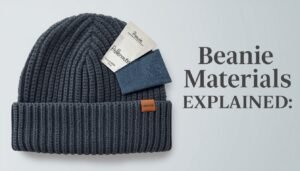
Thermal efficiency in beanie materials is defined by the inverse...
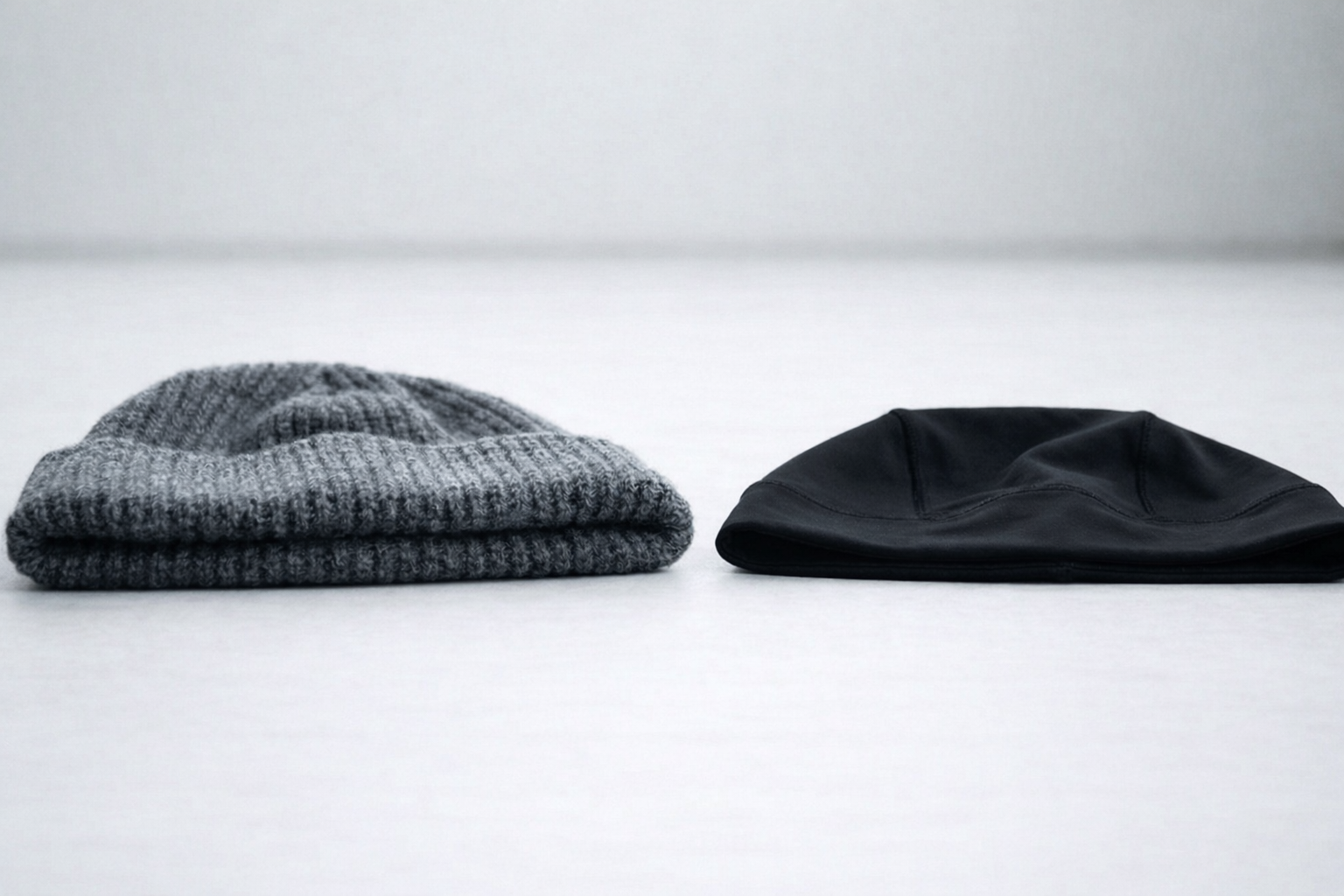
A Cuffless Beanie is not the same as a Skull Cap; the former is a thermal insulator designed with positive ease for warmth, while the latter is a moisture-wicking performance liner designed with negative ease for heat dissipation and helmet compatibility.
Because cuffless beanies sit close to the head, many people ask whether a cuffless beanie is the same as a skull cap.
The confusion between a Cuffless Beanie and a Skull Cap typically stems from silhouette similarities.
However, the functional physics of a Cuffless Beanie and a Skull Cap are opposite.
A Cuffless Beanie prioritizes heat retention through insulation.
A Skull Cap prioritizes heat rejection through evaporation.
1. Why You Must Distinguish Between a Cuffless Beanie vs. Skull Cap
The distinction between a Cuffless Beanie and a Skull Cap is critical because they perform opposing thermoregulatory functions: one traps heat to prevent hypothermia, while the other expels heat to prevent overheating.
Preventing Discomfort: Skull Cap Compression vs. Cuffless Beanie Ease
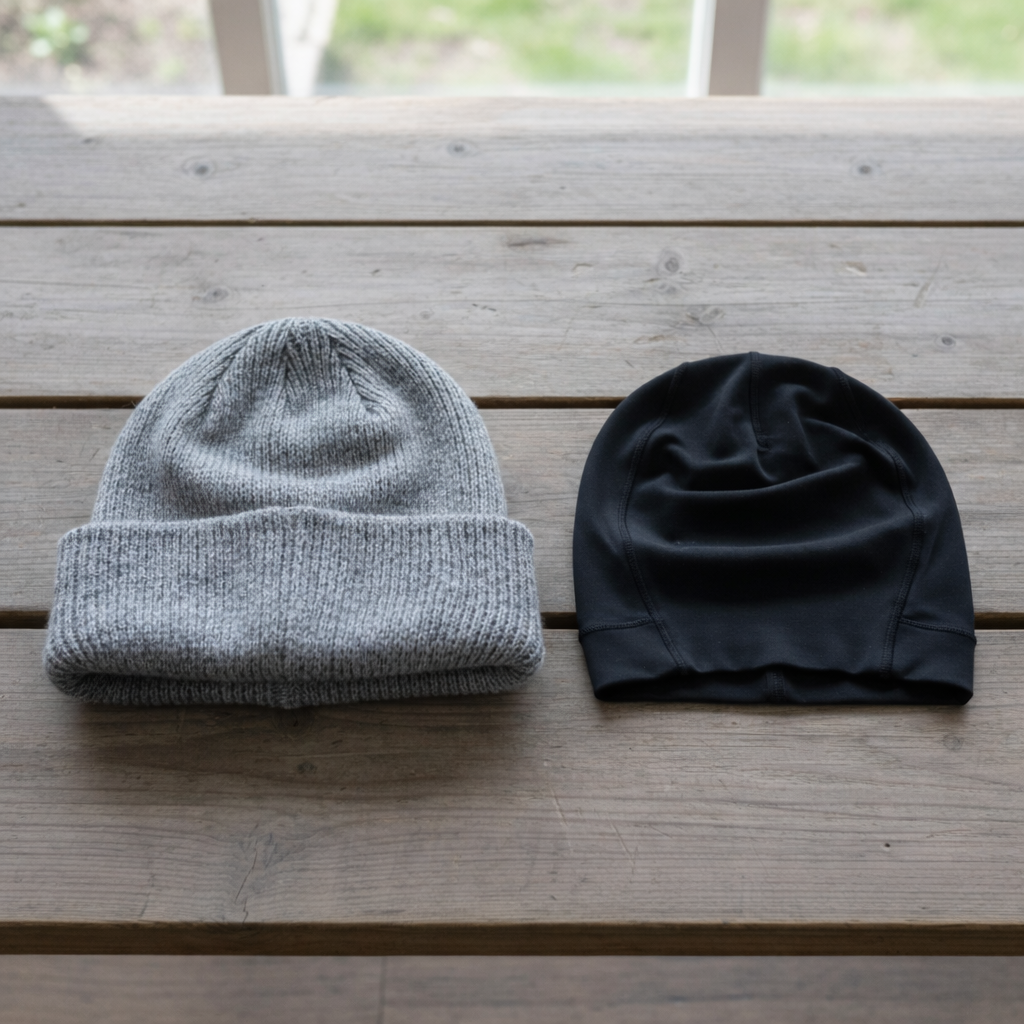
The difference in comfort between a Cuffless Beanie and a Skull Cap results from their opposing fit standards: “positive ease” versus “negative ease.”
Skull Caps utilize “negative ease” (a circumference typically smaller than the head) to ensure a zero-slip fit for active use.
This tight construction anchors the fabric against the skin to facilitate moisture transfer during high-movement activities.
Cuffless Beanies utilize “positive ease” (a relaxed fit) to provide the air-trapping volume necessary for insulation.
This loose construction allows for a layer of warm air to reside between the scalp and the fabric.
External compression headaches often result from wearing a Skull Cap for static leisure due to prolonged pressure on the scalp’s fascia.
A Cuffless Beanie eliminates this risk by distributing tension evenly or removing it entirely.
Comparing Thermoregulation: Cuffless Beanie Insulation vs. Skull Cap Wicking
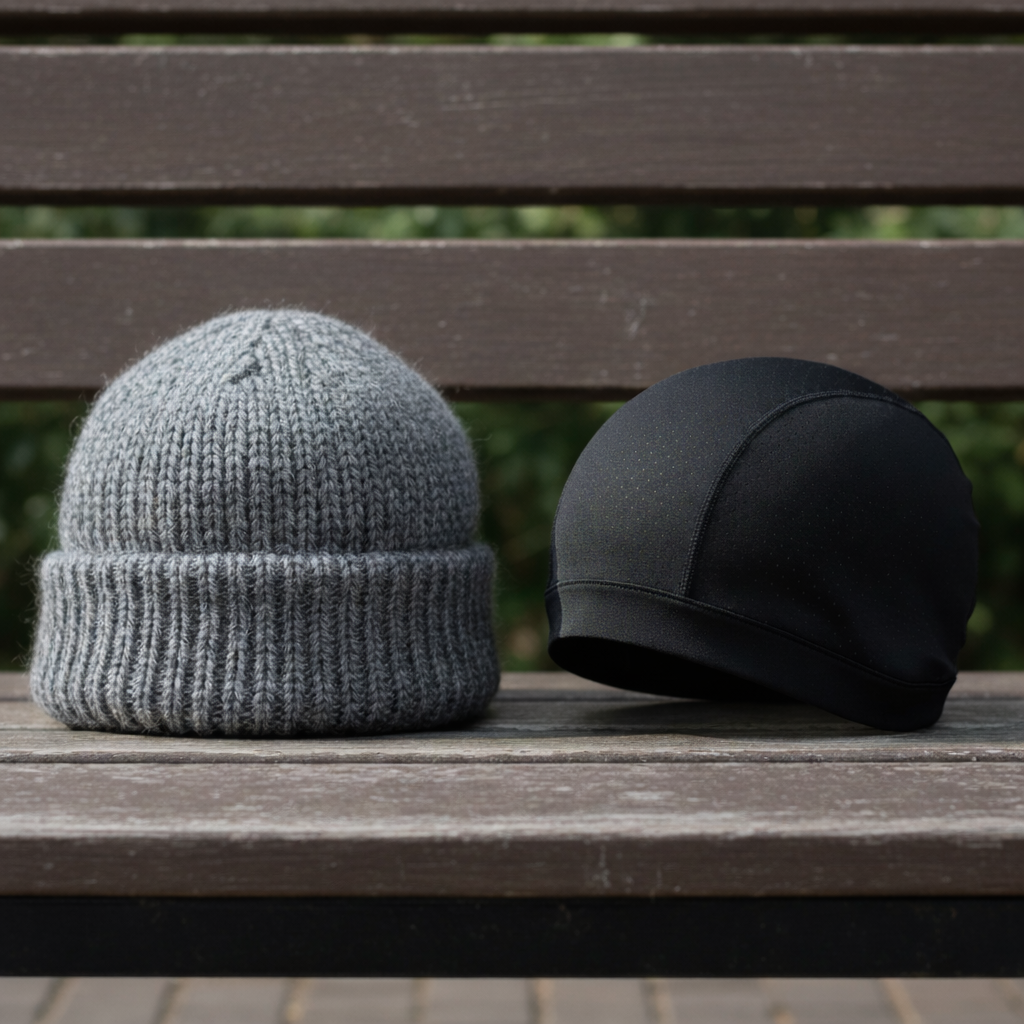
The difference in thermoregulation between a Cuffless Beanie and a Skull Cap is fundamental, as one relies on lofted fibers to insulate while the other relies on thin synthetic meshes to wick.
Cuffless Beanie wool fibers trap static air pockets to prevent convective heat loss.
This mechanism relies on the thickness and loft of the yarn to create a thermal barrier against cold ambient air.
Skull Cap hydrophobic mesh transports moisture to the surface to facilitate evaporative cooling.
Efficient wicking typically requires a material thickness of less than 1 mm to minimize the distance moisture must travel to evaporate.
2. How to Visually Identify a Cuffless Beanie vs. Skull Cap by Construction
Visual identification of a Cuffless Beanie versus a Skull Cap requires analyzing fabric density, seam construction, and the silhouette profile at the crown.
Table 1: Cuffless Beanie vs. Skull Cap Physical Specification Comparison
| Specification | Cuffless Beanie | Skull Cap |
| Fabric Density (GSM) | >200 GSM (High Density) | <150 GSM (Lightweight) |
| Seam Construction | Overlock (Bulky/Durable) | Flatlock (Flush/Zero-Chafe) |
| Material Composition | Natural Fibers (Wool/Cotton) | Synthetics (Spandex/Polyester) |
Inspecting the Silhouette: Cuffless Beanie Slouch vs. Skull Cap Contour
The visual difference between a Cuffless Beanie and a Skull Cap is observable at the crown, where positive ease creates a “Reservoir Tip” or slight fabric pooling.
This extra fabric creates a visual height difference, often standing up or slouching 1–2 inches above the scalp.
A Skull Cap traces the anatomical “parietal curve” of the skull perfectly.
This silhouette matches the head shape exactly to fit underneath other gear without bunching.
Checking Seam Types: Skull Cap Flatlock vs. Cuffless Beanie Overlock
The structural difference between a Skull Cap and a Cuffless Beanie often lies in the stitching method, with the former requiring flush seams for helmet clearance.
Skull Caps require Flatlock Stitching (butt-jointed seams) to maintain a zero-profile fit.
Flatlock seams join fabrics edge-to-edge, ensuring the thickness at the seam equals the thickness of the single layer to prevent pressure points.
Cuffless Beanies typically utilize Overlock seams.
These bulky ridges create a raised internal profile acceptable for casual wear but painful under rigid headgear.
3. When to Wear a Cuffless Beanie vs. When to Select a Skull Cap
Metabolic output and protective headgear requirements determine whether to select a Cuffless Beanie or a Skull Cap.
Choosing a Skull Cap (Not a Cuffless Beanie) for MIPS Helmet Compatibility
A Skull Cap preserves the safety tolerance of MIPS (Multi-directional Impact Protection System) helmets due to its sub-millimeter thickness, unlike a Cuffless Beanie.
MIPS relies on a low-friction layer inside the helmet to rotate slightly upon impact, reducing rotational forces transmitted to the brain.
Cuffless Beanies compromise helmet safety by adding bulk that alters the helmet’s fit.
Thick fabric reduces helmet clearance, which increases traumatic brain injury risk if the helmet cannot rotate independently of the head.
Wearing a Cuffless Beanie (Not a Skull Cap) for Static, Low-MET Activities
Cuffless Beanies function best in “Low-MET” (Metabolic Equivalent of Task < 3.0) scenarios, unlike Skull Caps which accelerate cooling.
Low-MET contexts include activities like commuting, ice fishing, or waiting at a bus stop where the body generates insufficient heat.
The body relies on the Cuffless Beanie’s thermal mass rather than metabolic heat in these static situations.
Skull Caps accelerate heat loss in these scenarios by wicking away what little heat the body produces, leading to rapid cooling.
4. How to Avoid Buying the Wrong Cuffless Beanie or Skull Cap Online
Avoiding the wrong Cuffless Beanie or Skull Cap requires ignoring marketing titles and verifying the “Material Composition” label for specific synthetic percentages.
Analyzing Titles for “Slouchy Skull Cap” to Identify Cuffless Beanies
The term “Slouchy Skull Cap” is a semantic contradiction used by marketers to sell Cuffless Beanies to a wider audience.
An item that “slouches” possesses positive ease and lacks the compression required to be a functional Skull Cap.
Consumers should classify any item labeled “slouchy” as a Cuffless Beanie regardless of other keywords.
Verifying Material Labels: Cuffless Beanie Wool vs. Skull Cap Spandex
Material composition labels provide the only undeniable proof of the distinction between a Cuffless Beanie and a Skull Cap.
A Skull Cap typically contains Spandex/Elastane content exceeding 10%.
High elastane content indicates the compression necessary for a negative-ease fit.
A Cuffless Beanie typically contains Acrylic or Wool content exceeding 90%.
High natural or acrylic fiber content indicates a prioritization of thermal retention over moisture transfer.
5. How to Finalize Your Choice: Cuffless Beanie or Skull Cap?
The final decision between a Cuffless Beanie and a Skull Cap requires a simple diagnostic of the intended activity’s intensity and safety requirements.
Table 2: Cuffless Beanie vs. Skull Cap Final Decision Matrix
| Activity | Required Feature | Winner |
| Winter Cycling (Helmet) | MIPS Compatibility | Skull Cap |
| Urban Commuting | Thermal Insulation | Cuffless Beanie |
| Marathon Running | Sweat Evaporation | Skull Cap |
| Camping/Sleeping | Comfort/Positive Ease | Cuffless Beanie |
The 3-Step Diagnostic Checklist: Cuffless Beanie vs. Skull Cap
This diagnostic checklist confirms the correct headwear selection based on functional constraints.
- [ ]A Skull Cap is the appropriate choice when wearing rigid protection like a helmet.
- [ ]A Cuffless Beanie is the appropriate choice when the activity involves a MET rate of < 3.0 (sedentary).
- [ ]A Cuffless Beanie is the appropriate choice when avoiding compression headaches is the priority.
If a skull cap is treated as a cuffless style, proper placement matters, which makes it important to know how a skull cap beanie should sit on the head.