Thermal efficiency in beanie materials is defined by the inverse...
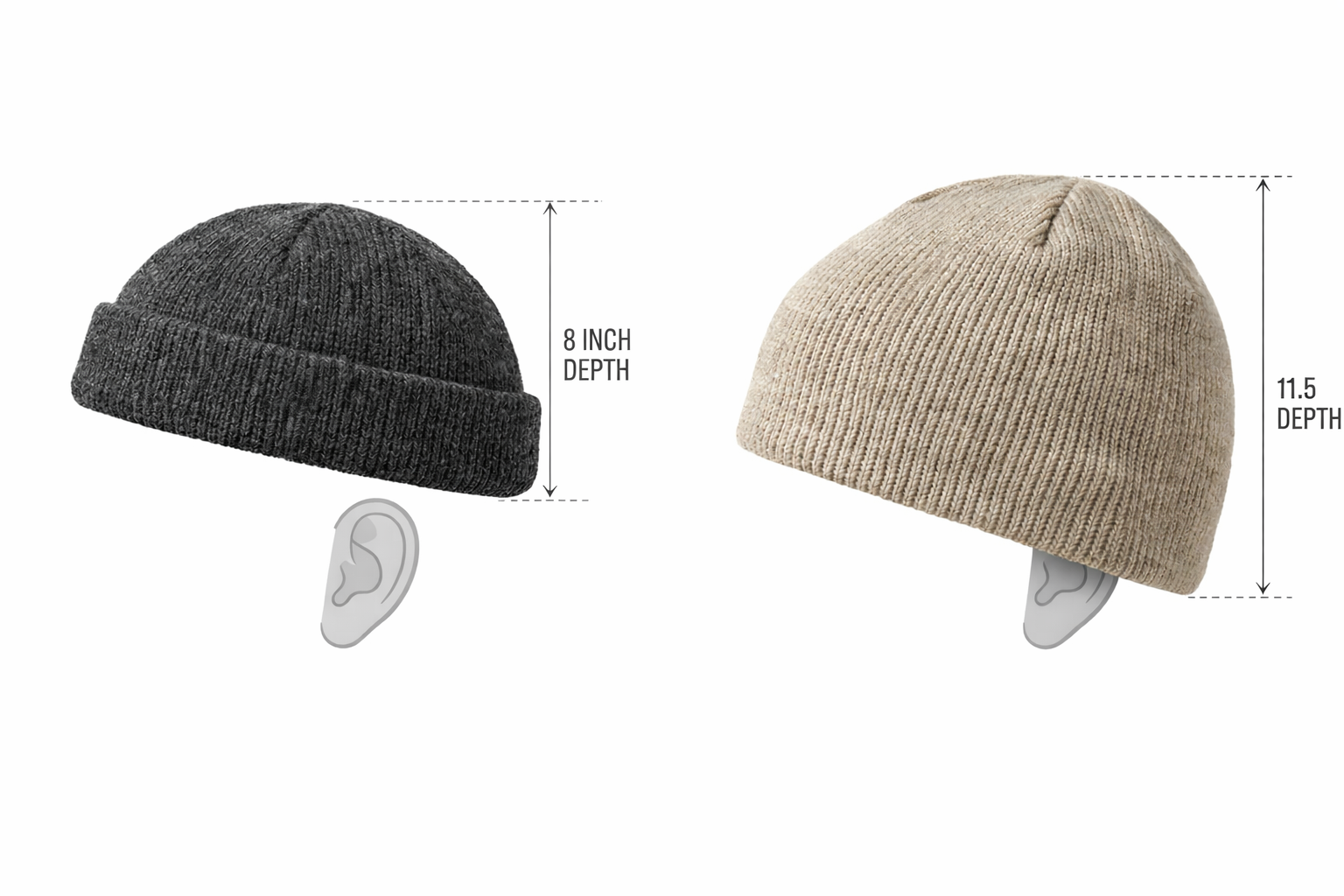
“Cuffless beanies” only provide full ear coverage if the unrolled vertical depth exceeds 11.5 inches, as standard 8-inch “Docker” styles are geometrically designed to sit above the ear. Many wearers experience the frustration of purchasing stylish Headgear that appears substantial online, only to find it lacks the necessary geometry to provide functional warmth in the Snow. A significant majority of the market consists of “Fisherman beanies” or “Docker” styles explicitly cut to a short depth of approximately 8 inches to expose the ears for aesthetic reasons. This creates a functional failure driven by physics: a short vertical depth fails to reach the earlobe, exposing sensitive cartilage to wind chill. This analysis examines Textile physics, minimum dimensions, and the “Flush-Fit” technique to solve this coverage deficit.
The Magic Number: Full ear coverage requires a minimum vertical crown-to-hem measurement of 11.5 inches for the average adult head.
Why Cuffless Beanies Often Fail to Cover Ears Fully
“Cuffless beanies” often fail to cover ears because horizontal stretch triggers vertical retraction, reducing the hat’s effective length. Understanding the geometry of a specific Knit cap is essential to diagnosing fit issues.
Distinguishing “Docker” Geometry from “Slouch” Geometry
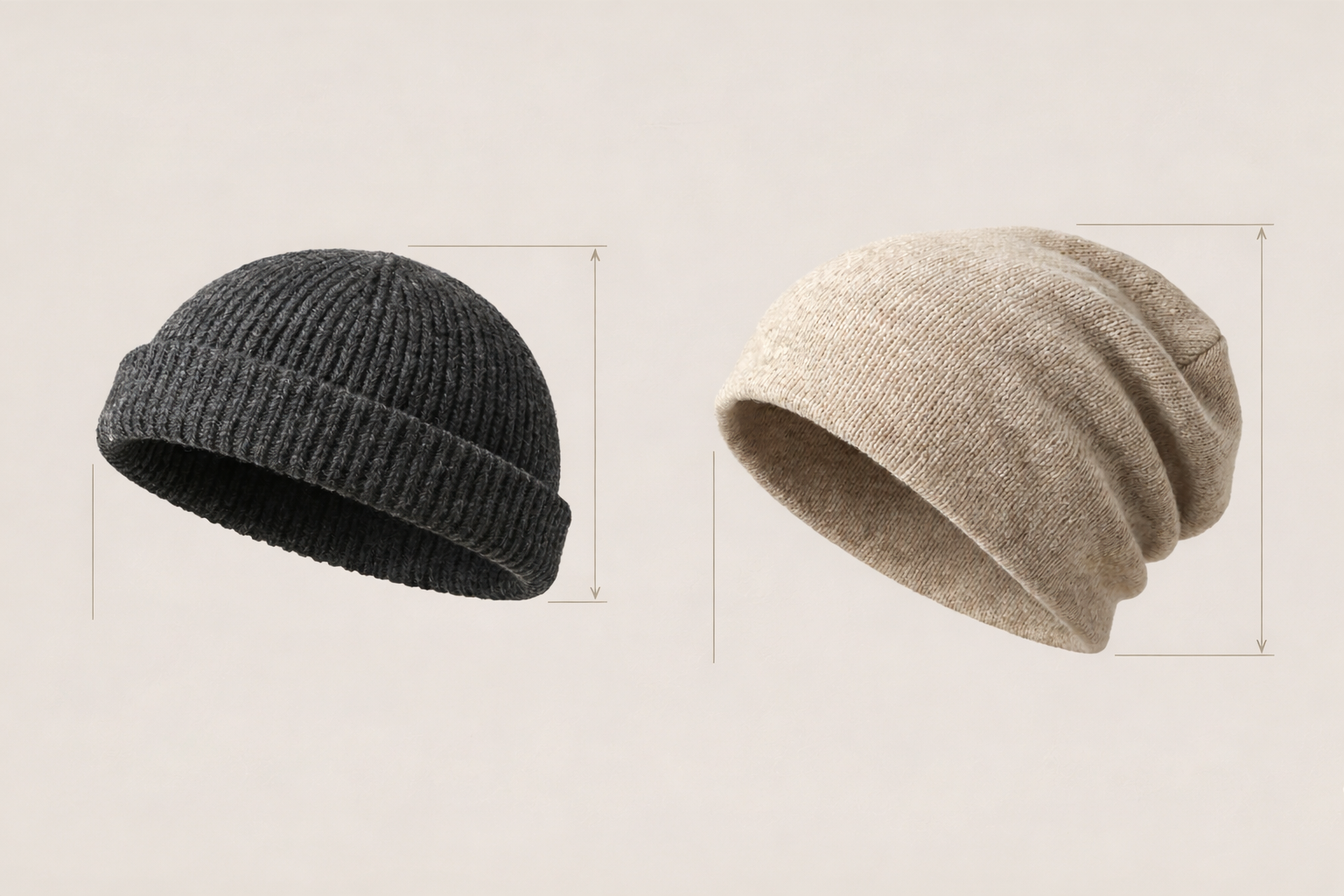
“Docker” or Fisherman beanies—often associated with the Hipster subculture—utilize a shallow crown cut measuring just 7–8 inches. In contrast, slouchy styles utilize a deep crown cut of 11–12 inches. The visual result is distinct: the Docker style sits high on the Forehead well above the ears, while the slouch style provides enough fabric to pool at the neck or cover the ear completely.
Calculating Horizontal Stretch vs. Vertical Retraction
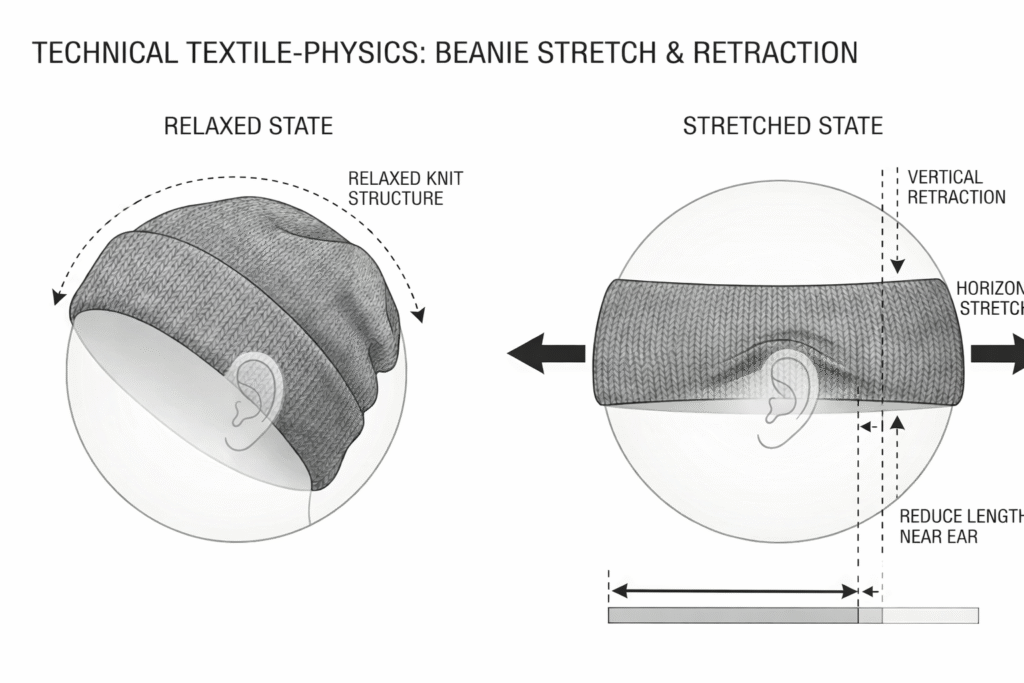
Knitting structure is finite; yarn displaced horizontally cannot simultaneously maintain vertical length. A wide head circumference consumes the fabric’s available width, which forcibly retracts the vertical length. Stretching a standard Knit cap over a 23-inch head typically reduces the available vertical length by approximately 0.5 to 1.0 inch.
Identifying the “Zero-Slack” Constraint of Cuffless Hems
A cuffed beanie possesses approximately 3.5 inches of stored fabric (the Cuff) that acts as adjustable slack to lengthen the hat. A “cuffless beanie” has zero adjustable slack; the factory cut defines its absolute maximum limit. Unlike a standard Cap which features an adjustable strap, the Knitting dimensions are fixed and cannot be altered once the yarn is cut.
What Features Ensure Cuffless Beanies Cover Ears?
Specific features ensure “cuffless beanies” cover ears, primarily a vertical depth exceeding the distance between the cranial crown and the earlobe.
When full ear coverage isn’t guaranteed, the question becomes why one would choose a beanie without a cuff. The answer lies in the specific features that make coverage possible.
Measuring the Crown-to-Hem Depth (The 11.5″ Standard)
The distance from The Crown of the head to the bottom of the earlobe averages 9.5 to 10.0 inches for adult males. A functional “cuffless beanie” must measure 11.0″–12.0″ flat to account for the 1.0″ retraction and still cover the lobe completely.
Analyzing Rib-Knit Elasticity (1×1 vs. Jersey)
The knit structure determines whether the hem holds its position or creeps upward. A 1×1 rib structure contracts horizontally, which locks the hem securely below the ear. Conversely, Jersey (t-shirt style) knits rely largely on friction and will often slide up on Hair, breaking the thermal seal.
Evaluating Wool GSM for Single-Layer Insulation
“Cuffless beanies” are typically single-layer and lack the thermal bulk of a folded rim or a Pom-pom hat. To match a double-layer cuffed beanie’s warmth (often 200 GSM x 2 layers = 400 effective GSM), a single-layer cuffless beanie requires heavyweight Wool rated at 350+ GSM.
How to Wear Cuffless Beanies for Maximum Ear Coverage
Maximizing ear coverage with “cuffless beanies” requires specific positioning techniques that counteract the fabric’s natural elasticity.
Executing the “Crown-Flush” Technique
Wearers often leave a fashionable “air gap” at the top of the Hat, wasting crucial fabric. Pulling the crown flush to the scalp eliminates this top air gap, reclaiming approximately 1.0″ of length for the ears.
Positioning the Rear “Slouch” Counterweight
Gravity affects the fit of slouchy styles. If extra fabric (“slouch”) hangs 45° outward, gravity leverages the front hem up (off the ears). Tuck the slouch vertically down the nape of the neck to correct this; the weight then anchors the front hem down over the ears.
Integrating Eyewear Without Breaking the Thermal Seal
Improper eyewear insertion creates wind tunnels. Insert glasses arms at an upward angle above the tragus (the small nub of the ear), keeping the “cuffless beanie” rim flush against the skin. This technique is crucial for those who wear glasses with their winter Gear.
When to Choose Cuffless Beanies vs. Cuffed Beanies
Choosing “cuffless beanies” versus cuffed variations depends on ambient Temperature and the required thermal resistance (R-value).
Comparing Thermal Resistance (R-Value Proxy)
Air trapped between layers is the primary insulator against Heat loss. Cuffed beanies trap air efficiently; cuffless beanies do not.
| Style | Layers | Wind Block | Temperature Limit |
| Cuffless | 1 Layer | Low Wind Block | 32°F (0°C) – Cool Climate |
| Cuffed | 2 Layers | High Wind Block | 10°F (-12°C) – Severe Weather |
Assessing Stability During High-Inertia Movement
Single-layer hems lack the structural tension of a folded cuff. High-inertia running motion jostles the single-layer rim, which breaks the ear seal. Cuffless styles work best for low-impact walking or Streetwear fashion, while cuffed styles are superior for Sportswear or skiing under a Helmet.
How to Buy Cuffless Beanies That Fit Properly (Checklist)
Buying properly fitting “cuffless beanies” requires filtering for three technical attributes: length, Material hydrophobicity, and elastane content.
Verifying Specifications via the “Fit Filter”
- Length: Is the flat vertical measurement >11.0 inches? (If No, ears will freeze).
- Material: Is it Hydrophobic (Wool) or Hygroscopic (Cotton)? Avoid Cotton for freezing temperatures as it retains moisture like a wet T-shirt.
Screening for Elastane Content (Memory)
Many 100% Acrylic knits suffer from hysteresis, losing shape and tension after short periods of wear. Look for 3–5% Spandex/Elastane in the blend to ensure “snap-back” retention against the ears.
Calculating Fit for Head Circumference >59cm
One Size Fits All (OSFA) has a mechanical limit. A head size >23″ (59cm) overstretches OSFA fabric, requiring XL specific sizing to maintain vertical coverage.
Conclusion
In summary, “cuffless beanies” provide full ear coverage only if the wearer prioritizes specific vertical dimensions over standard “Docker” styling. The “Magic Number” of 11.5 inches and a high fabric density (GSM) are non-negotiable for functionality. While the docker style is a Fashion staple for the modern Wardrobe, functional Warmth requires verifying measurements, not just style. Choosing the right Option depends on whether you prioritize Personal Style or Climate protection.