Thermal efficiency in beanie materials is defined by the inverse...
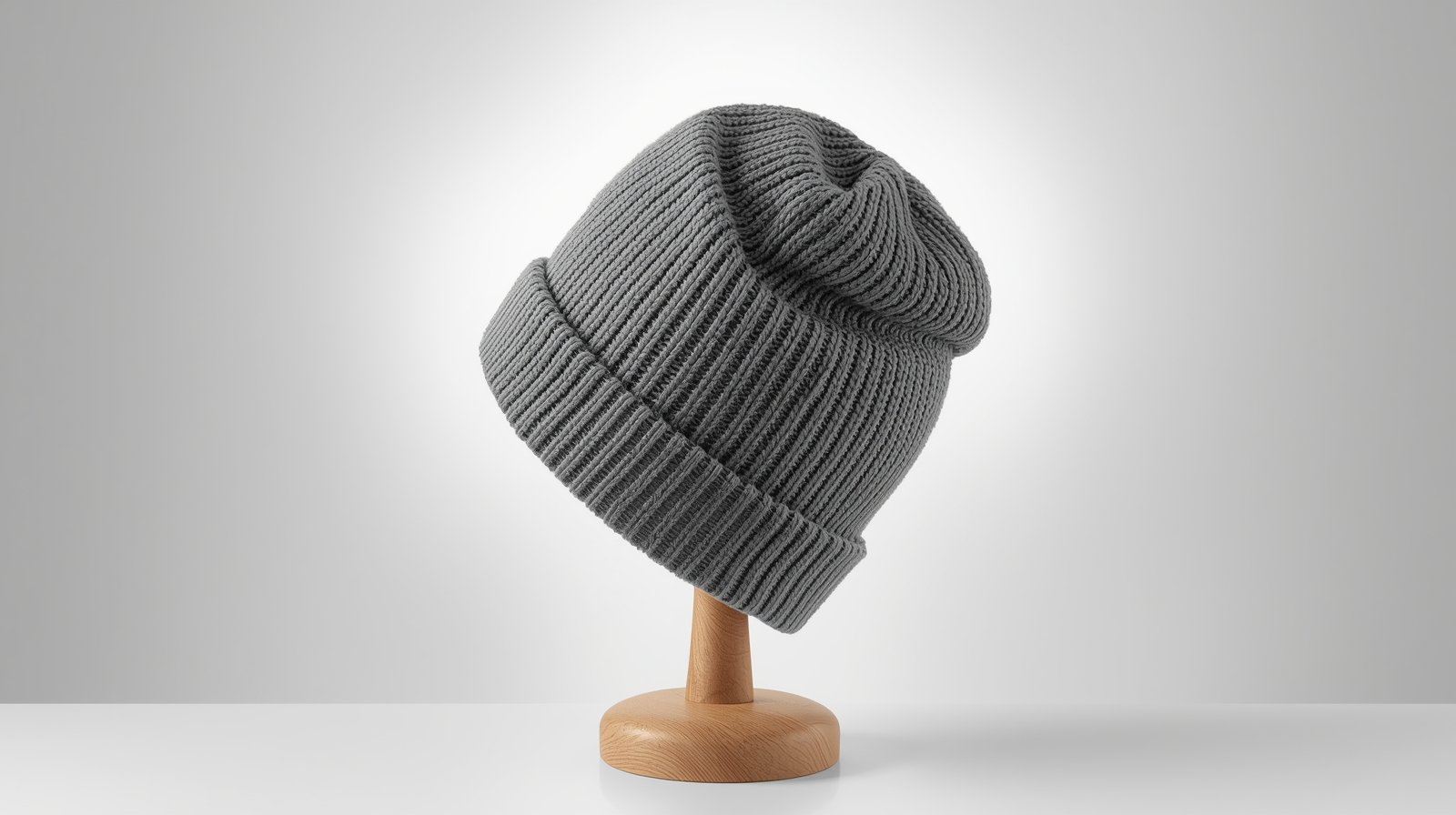
Crown shapes, cuff styles, and vertical depth define beanies by controlling structural stability, thermal performance, and positional fit on the head. These three variables govern how fabric tension distributes across the skull, how heat is retained or released, and where the beanie terminates relative to the ears and forehead. Unlike structured hats, beanies rely entirely on knit mechanics and textile elasticity, making their engineering decisive.
Proper beanie design depends on how crown geometry interacts with cuff construction and depth. When these elements are correctly aligned, a beanie maintains stability and function. When misaligned, the beanie deforms, slips, or collapses into predictable failure patterns.
Why You Must Analyze Crown Shapes to Prevent Fit Issues
Analyzing crown shapes prevents fit failure because knit tension must align with skull anatomy to neutralize elastic recoil. When crown curvature mirrors cranial geometry, elastic energy dissipates evenly instead of forcing displacement.
Ignoring crown analysis produces two dominant failure modes: upward ejection caused by elastic recoil and lateral widening caused by excessive textile stiffness. Both failures originate from architectural mismatch rather than user error.
Why Ignoring Crown Architecture Causes the “Pop-Off” Effect
The “Pop-Off” effect occurs when a conical crown is forced over the spherical anatomy of the parietal ridge. This mismatch stores elastic potential energy inside the knit structure.
As the textile attempts to recover its original shape, stored energy converts into upward force. Lightweight fibers such as acrylic intensify this effect because they lack the mass and adaptive memory found in wool or merino, allowing the crown to eject upward instead of settling.
How Misjudging Depth Distorts the Crown Shape into a “Mushroom” Silhouette
“Mushrooming” occurs when stiff knit structures resist vertical drape under gravity. Instead of collapsing downward, excess fabric expands laterally.
Rigid ribbing and high-stiffness knits prevent controlled apex collapse. The fabric spreads horizontally, widening the crown and producing a bulbous silhouette that destabilizes fit and proportion.
How Crown Shapes Determine the Beanie’s Structural Silhouette
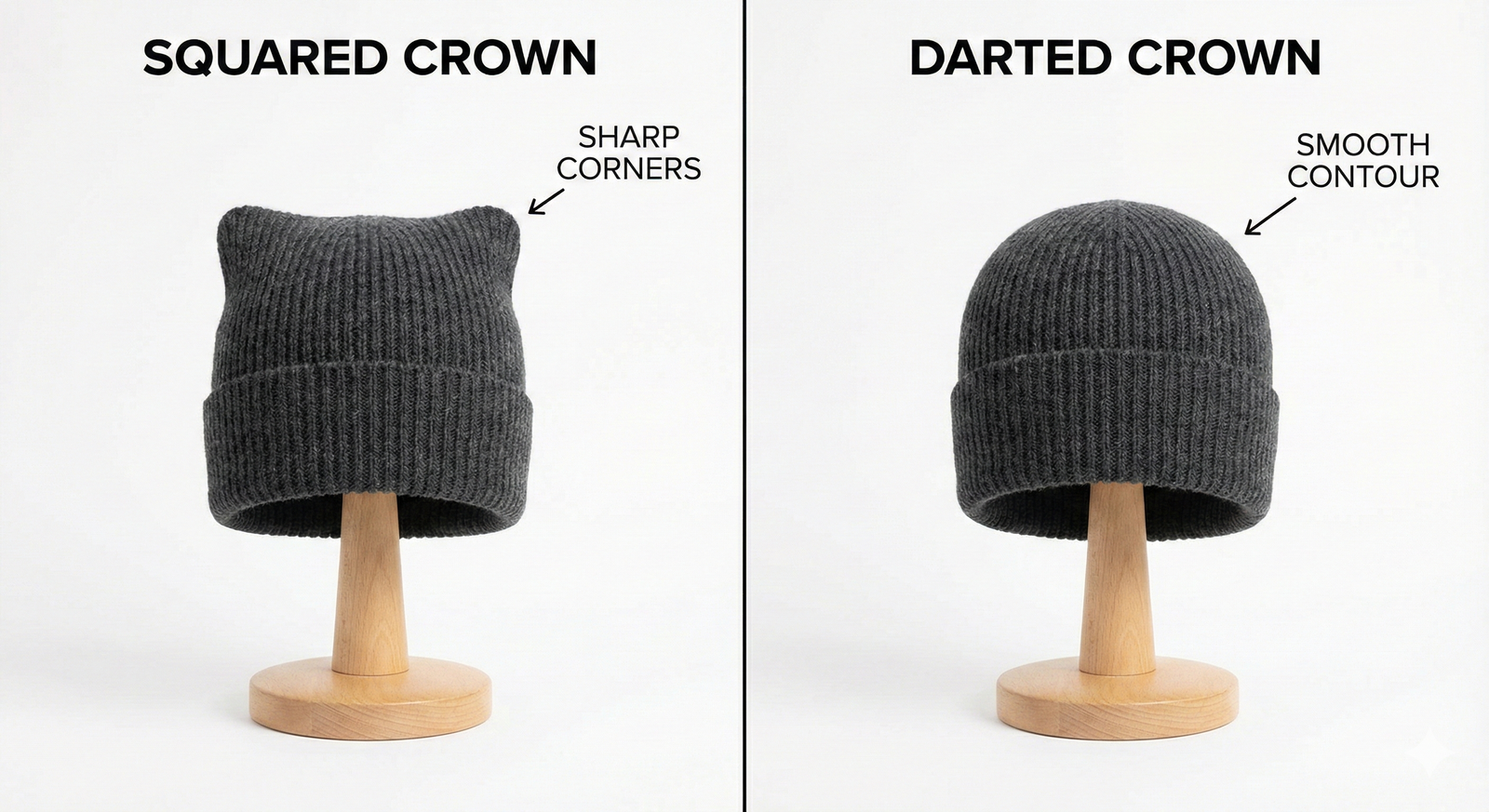
Crown shapes determine silhouette through the method used to close the apex. Knitting decrease patterns either contour fabric smoothly around the skull or force angular geometry into the crown.
Radial decrease systems produce curved, anatomical forms. Linear closure systems generate angular edges. This single construction decision defines whether a beanie appears rounded or box-like.
How Darted Crown Shapes Create a Contoured, Spherical Profile
Darted crown shapes create spherical profiles by using six-point full-fashioned decreases at the apex. These decreases remove excess fabric in a controlled radial pattern.
Darted crowns reduce apex fabric mass by approximately 15–20% compared to squared seams. Radial stitching eliminates angular corners and allows the crown to conform closely to skull geometry, producing stable fit without bunching.
When to Choose Squared Crown Shapes for a Trapezoidal Aesthetic
Squared crown shapes form trapezoidal silhouettes when linear seams force knit corners outward. This structure results from tubular knit closures that restrict radial expansion.
Lateral corner projection produces a box-like profile commonly used in cuffed beanies and workwear styles. This geometry emphasizes structure but can limit vertical fabric redistribution in deep-cuff designs.
Crown Shape Comparison Matrix
| Crown Type | Apex Closure | Fabric Behavior | Fit Stability | Visual Profile |
|---|---|---|---|---|
| Darted Crown | Radial full-fashioned decreases | Controlled vertical collapse | High | Rounded, anatomical |
| Squared Crown | Linear tubular seam | Lateral corner projection | Moderate | Boxy, trapezoidal |
How Cuff Styles Modify the Thermal Profile of the Crown Shape
Cuff styles modify thermal performance by doubling material density at the forehead. A folded cuff increases insulation where heat loss is highest.
While crown shape governs fit, cuff construction determines localized warmth. Merino wool retains insulation when wet, cotton provides minimal thermal resistance, and acrylic offers moderate warmth with limited breathability.
Why Cuffed Crown Shapes Increase R-Value via Layering
Cuffed crown shapes increase insulation by trapping dead air space between folded textile layers. This trapped air raises effective R-value by approximately 40%.
Stationary air pockets reduce convective heat loss and shield the forehead and ears from wind exposure, prioritizing warmth over low-profile design.
When to Select Uncuffed Crown Shapes for Aerodynamic Layering
Uncuffed crown shapes maintain single-layer profiles that sit flush against the head. Typical thickness remains under 3 mm.
This streamlined construction reduces bulk and interference under helmets, making uncuffed beanies ideal for cycling, skiing, and layered systems.
How Vertical Depth Dictates the Crown Shape’s Coverage Area
Vertical depth defines the distance from apex to hem. This measurement determines ear coverage, slouch formation, and crown dominance.
Depth is the primary variable controlling where unsupported fabric accumulates and how the beanie visually balances on the head.
How Shallow Depth (7.5″–8.5″) Exposes the Crown Shape
Shallow depth terminates above the ear helix, exposing the ears and emphasizing crown geometry. This configuration produces the docker profile.
Restricted depth isolates the crown visually at the top of the head, making structural precision immediately noticeable.
Why High Depth (>11″) Collapses the Crown Shape into a Slouch
High depth exceeds cranial vertical measurement. Excess fabric succumbs to gravity and folds downward into a slouch.
This drape results from unsupported vertical mass rather than engineered shaping.

How to Match Crown Shapes to Your Face Shape
Matching crown shapes to face shape requires selecting silhouettes that correct visual imbalance in facial proportions. Crown geometry alters perceived verticality and width.
Proper matching improves optical symmetry between headwear and facial structure.
How to Balance Round Faces with Verticality (Squared / Deep)
Squared crown shapes balance round faces by introducing angular lines that interrupt circular geometry. Increased depth adds vertical emphasis.
This combination visually narrows cheek width and shifts proportions upward.
How to Soften Square Jaws with Organic Curves (Darted / Cuffed)
Darted crown shapes soften square jaws by introducing spherical curvature. Rounded construction diffuses sharp mandibular lines.
Cuffed designs further stabilize proportions by anchoring the crown lower on the forehead.
How to Validate Crown Shapes with a Pre-Purchase Checklist
Validating crown shapes requires inspecting construction quality and elastic recovery. These checks ensure long-term fit retention.
How to Perform the “Seam & Stretch” Inspection on Crown Shapes
The seam and stretch inspection distinguishes full-fashioned decreases from cut-and-sew closures. Full-fashioned seams show clean V-shaped reductions, while cut-and-sew seams show serged edges.
Elastic recovery confirms whether the knit returns to original width after controlled stretching.
The Perfect Fit Action Checklist
☐ Crown Structure: Inspect the apex for full-fashioned V-shaped decreases rather than serged seams.
☐ Elasticity Test: Stretch to 150% of resting width; recovery must occur within two seconds.
☐ Weight Check: Ensure embellishments do not distort crown tension or silhouette.